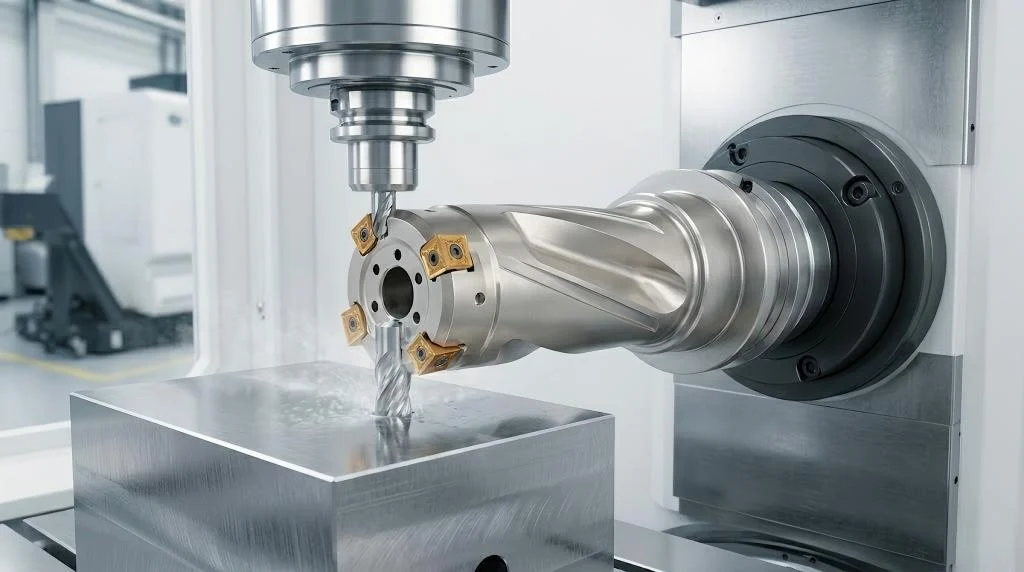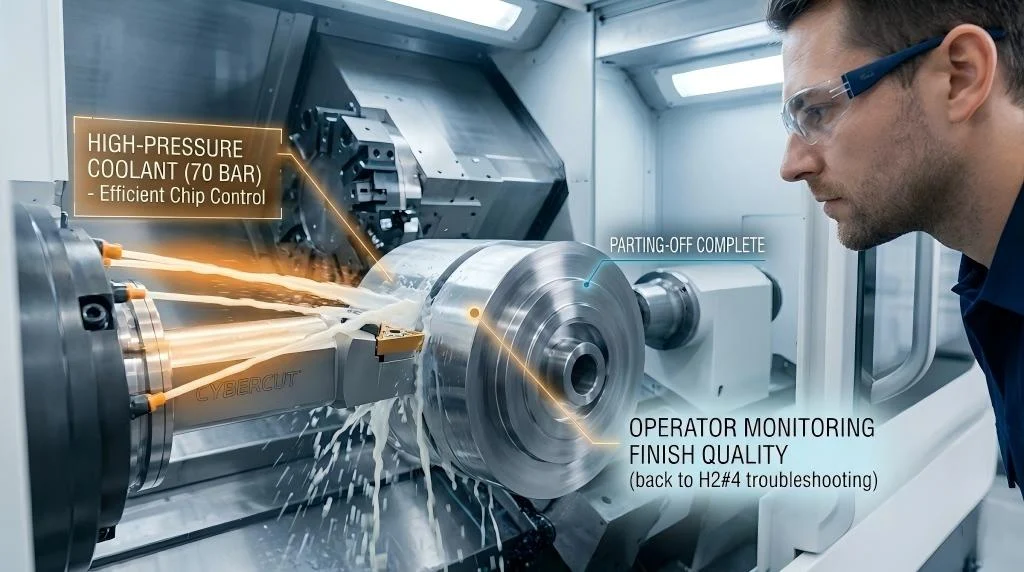
In the rigorous environment of industrial CNC machining, facilities routinely invest hundreds of thousands of dollars in state-of-the-art milling centers and premium solid carbide cutting tools. Yet, the critical interface connecting these two massive investments—the tool holder—is frequently treated as an afterthought. Machining is fundamentally a mechanical chain, and that chain is only as strong as its weakest link. If your CNC tool holders and collets are compromised by dirt, wear, or improper assembly, the precision of your machine spindle and the cutting edge geometry of your end mills are rendered completely useless.
Neglecting the maintenance of your precision machining accessories introduces catastrophic variables into your production process: uncontrollable Total Indicator Runout (TIR), severe tool deflection, micro-chatter, premature insert failure, and in severe cases, catastrophic damage to the machine’s spindle taper. Establishing a strict, uncompromising maintenance protocol for your premium CNC tool holders is not a housekeeping suggestion; it is a mandatory engineering requirement for achieving tight tolerances and lowering your cost-per-part. This comprehensive guide will dissect the mechanics of tool holder wear, the physics of proper torque, and the exact procedures required to maximize the lifespan of your critical clamping systems.
How Dirty Collets Affect Spindle Runout and Tool Life

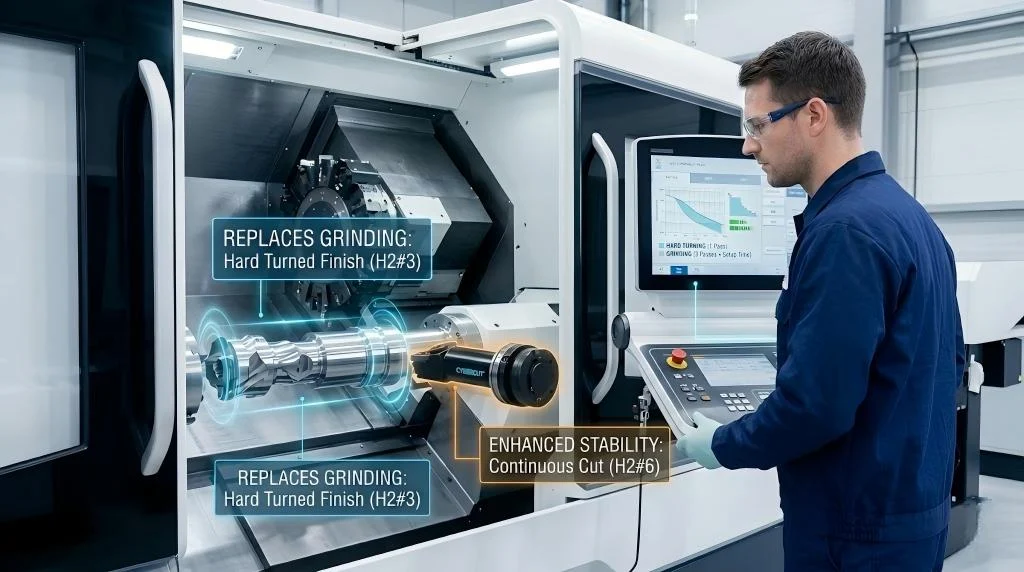
The fundamental purpose of a collet chuck is to perfectly align the centerline of the cutting tool with the centerline of the machine spindle. This alignment relies on the flawless mating of highly precise, ground conical surfaces. When shop floor realities set in, microscopic debris inevitably infiltrates the tool holder assembly. When a cutting tool is clamped into a dirty collet, or a dirty collet is forced into a dirty holder taper, this debris acts as a microscopic wedge.
The Physics of Induced Runout

Consider a tiny particle of steel swarf, measuring just 0.001″ (25 microns) in thickness, trapped between the collet and the internal taper of the holder. This particle physically pushes the tool off-center. When the spindle rotates, the cutting tool will now orbit the true centerline rather than rotating concentrically. This is known as Total Indicator Runout (TIR).
The consequences are destructive: Asymmetrical chipload negates feed parameters. Exponential tool wear occurs—just 0.0001″ of TIR can reduce tool life by 10%. Furthermore, fretting wear causes the tool holder to microscopically vibrate, permanently destroying the accuracy of the CNC tool holders.
Understanding the Importance of Proper Torque Specifications
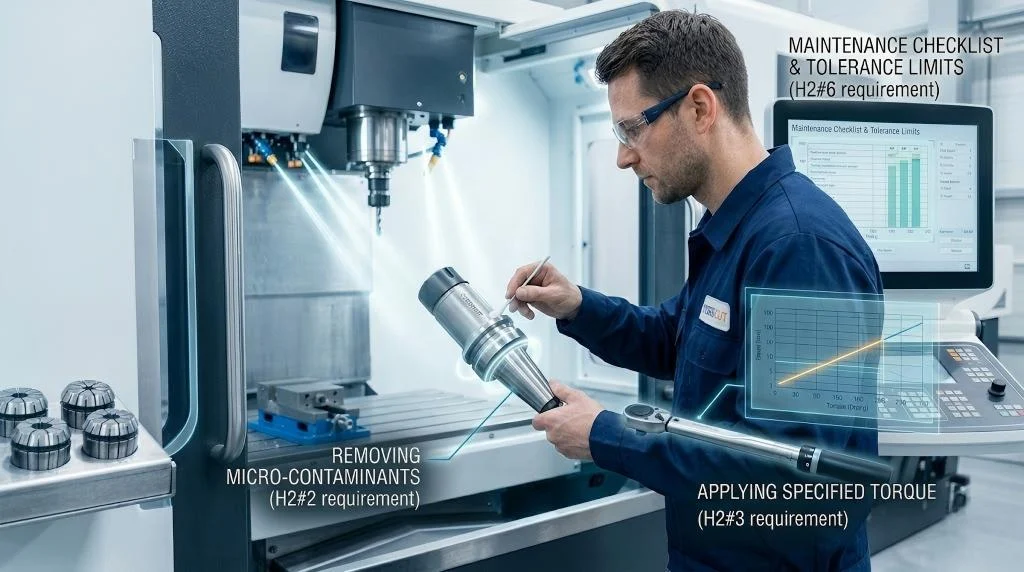
The vast majority of machinists rely on “feel” when tightening collet nuts. They use a standard spanner wrench and strike it with a mallet. This practice is universally condemned by tool holder engineers and is a primary cause of accessory failure.
The Danger of Under-Tightening
If a collet nut is under-torqued, it does not generate sufficient gripping friction. During heavy roughing, the helical flutes of the end mill act like a screw. Cutting forces will physically pull the tool out of the collet, resulting in a catastrophic crash.
The Engineering Reality of Over-Tightening
Over-tightening forces the collet too far down into the taper, causing distortion of the collet cone. It concentrates pressure at the back, causing the front to flare out (bell-mouthing). Excessive torque also stretches the threads on the body of the precision machining accessories. To guarantee repeatable precision, operators must use a calibrated torque wrench and a dedicated tool-tightening fixture block.
[Table] Runout Tolerance Standards for Standard vs. Ultra-Precision ER Collets
Not all collets are manufactured to the same metrological standards. The globally recognized standard for ER collets is DIN 6499. When upgrading your inventory with specialized CNC collets and holders, you must choose the precision class that matches your machining tolerances.
| ER Collet Size | Clamping Range (mm) | Standard Class TIR (DIN 6499 Class 2) | Precision Class TIR (DIN 6499 Class 1) | Ultra-Precision Class TIR (UP / AA) |
| ER11 | 1.0 – 7.0 | ≤ 0.015 mm (0.0006″) | ≤ 0.010 mm (0.0004″) | ≤ 0.005 mm (0.0002″) |
| ER16 | 1.0 – 10.0 | ≤ 0.015 mm (0.0006″) | ≤ 0.010 mm (0.0004″) | ≤ 0.005 mm (0.0002″) |
| ER20 | 1.0 – 13.0 | ≤ 0.015 mm (0.0006″) | ≤ 0.010 mm (0.0004″) | ≤ 0.005 mm (0.0002″) |
| ER25 | 1.0 – 16.0 | ≤ 0.015 mm (0.0006″) | ≤ 0.010 mm (0.0004″) | ≤ 0.005 mm (0.0002″) |
| ER32 | 2.0 – 20.0 | ≤ 0.020 mm (0.0008″) | ≤ 0.010 mm (0.0004″) | ≤ 0.005 mm (0.0002″) |
*Engineering Note: A Standard Class collet is perfectly acceptable for general roughing. However, for high-speed finishing, investing in Ultra-Precision ER collets is mathematically required to prevent premature tool wear.*
Step-by-Step Cleaning and Rust Prevention Procedures
Implementing a daily and weekly Preventative Maintenance (PM) schedule for your CNC tool holders will drastically extend their lifespan and ensure maximum spindle longevity.
- Disassembly and Degreasing: Never store an assembled tool holder with a tool still clamped inside. Submerge the collet and nut in a non-corrosive, industrial degreasing solvent. Ultrasonic cleaners are highly recommended.
- Physical Agitation and Wiping: Use specialized brass-bristled brushes. Never use steel wire brushes or abrasive pads (like Scotch-Brite), which destroy the micro-finish.
- Spindle Taper Maintenance: Cleaning the holder is futile if the machine’s spindle is contaminated. Use a dedicated spindle taper wiper.
- Lubrication and Rust Prevention: After drying, components must be protected from oxidation. The internal taper of the premium tool holderand the exterior of the collet should be wiped with a low-viscosity rust-preventative oil. Do not use heavy greases, which induce runout.
When is it Time to Replace Your Collets and Tool Holders?
A dangerous assumption is that steel tool holders last forever. They are wear items. Trying to save $30 on a new collet will systematically destroy $150 end mills.
Visual and Metrological Replacement Indicators
- Fretting and Scoring: If the external taper displays rust-colored bands or pitting, its lifespan has ended.
- Loss of Collet Spring Tension: If you press a collet into a nut and the segments feel entirely rigid, the steel has fatigued and will no longer apply even radial clamping force.
- TIR Metrology Failures: The ultimate test is measurement. Clamp a certified gauge pin into your precision CNC tool holders. Mount the holder in a V-block and apply a dial test indicator. If runout exceeds DIN specifications, the assembly is geometrically compromised and must be scrapped.
Frequently Asked Questions (FAQ)
Q1: How often should I clean my CNC tool holders?
A: Wipe down exterior tapers before every tool change. A full tear-down and ultrasonic cleaning should be performed every time you change out a dull cutting tool for a new one, or weekly for high-volume tools.
Q2: Can I use sandpaper or Scotch-Brite to clean a rusty tool holder?
A: Absolutely never. Tool holder tapers are precision ground to AT3 tolerances or better. Any abrasive pad will immediately destroy this geometric tolerance, rendering the holder out-of-round.
Q3: What is the difference between an ER collet and a TG collet?
A: ER collets have an 8-degree taper angle, allowing a wide collapse range. TG collets have a shallower 4-degree taper, requiring more force to seat but generating vastly superior gripping friction for heavy roughing.
Q4: Why is my end mill pulling out of the collet during heavy roughing?
A: Pull-out is caused by cutting forces overcoming collet friction. Causes include under-tightening, trapped oil acting as a lubricant, or fatigued collets. For extreme roughing, upgrade to milling chucks or shrink-fit high-performance tool holders.
Q5: Do pull studs (retention knobs) need maintenance or replacement?
A: Yes. They endure immense cyclic tensile stress from the machine’s drawbar. They must be torqued to exact specifications and proactively replaced every 1 to 2 years to prevent catastrophic metallurgical fatigue failure.
Q6: How does a balanced tool holder differ from an unbalanced one, and when is it necessary?
A: Balanced tool holders are dynamically tested and have material removed to perfectly center their mass. At high spindle speeds (above 10,000 RPM), unbalanced tools create extreme vibration. Balancing is mandatory for High-Speed Machining (HSM).