In the realm of modern manufacturing, machining components that exceed a hardness of 45 HRC (Rockwell Hardness Scale C) has historically been an expensive, time-consuming, and logistically complex endeavor. For decades, the industry standard dictated that parts should be machined in their “soft” or annealed state, sent out for bulk heat treatment, and then returned for final dimensional finishing using cylindrical grinding machines. This workflow, while reliable, is inherently flawed due to massive capital equipment requirements, extensive cycle times, and the environmental hazards associated with grinding swarf and coolant disposal.
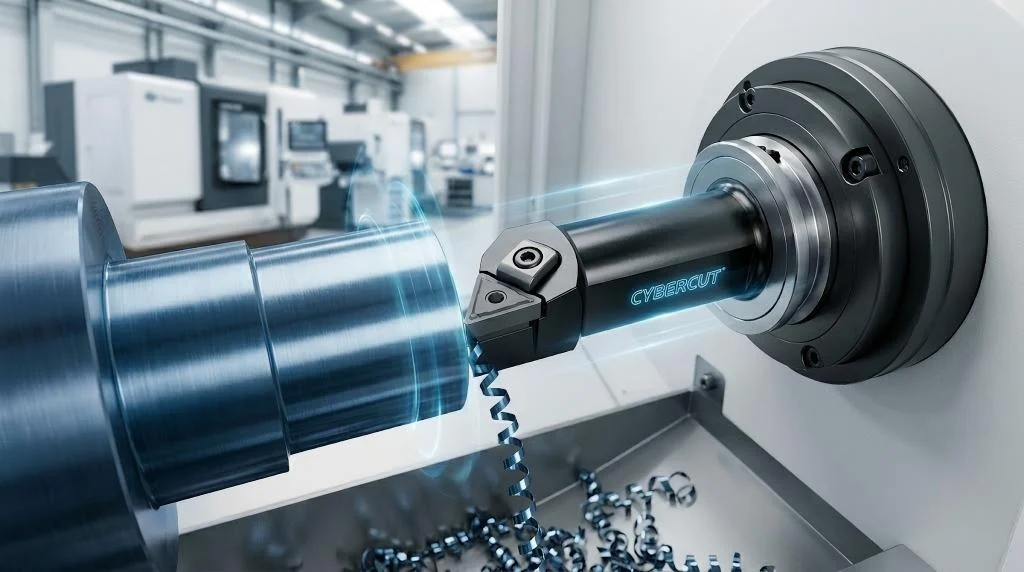
The advent and continuous refinement of PCBN cutting tools (Polycrystalline Cubic Boron Nitride) have fundamentally disrupted this archaic workflow, ushering in the era of Hard Part Turning (HPT). By utilizing inserts engineered from the second hardest material known to mankind, machine shops can now finish-turn fully hardened steel shafts, gears, and bearing rings directly on standard CNC lathes. This capability eliminates the grinding bottleneck entirely. However, applying superhard materials requires a paradigm shift in machining philosophy. Traditional carbide principles do not apply here. Misapplying a PCBN insert results in instant, catastrophic tool fracture. This comprehensive engineering guide will decode the complex metallurgy of cubic boron nitride, analyze the strict rigidity requirements for hard turning, and provide the exact edge preparation strategies necessary to maximize the ROI of your PCBN cutting tools.
What is PCBN and Why is it Essential for Hardened Steel?

To grasp why standard carbide fails and PCBN succeeds, we must examine the tribology and chemistry of the cutting edge at temperatures exceeding 1000°C. When machining hardened steel (typically ISO H materials ranging from 45 to 65 HRC), the shear forces generate immense friction. Standard tungsten carbide, even with advanced CVD coatings, will suffer from rapid plastic deformation (melting) and severe abrasive wear within seconds.
The Chemistry of Superhard Materials

Polycrystalline Cubic Boron Nitride is a synthetic super-material synthesized under ultra-high pressure and high temperature. It consists of micron-sized cubic boron nitride grains bound together by a specialized matrix. A common question among machinists is: If diamond is the hardest material on Earth, why don’t we use Polycrystalline Diamond (PCD) to cut hardened steel?
The answer lies in chemical thermodynamics. Diamond is pure carbon. At the extreme temperatures generated during steel machining, the carbon in the diamond reacts violently with the iron in the steel. The diamond physically dissolves into the workpiece in a process known as graphitization. PCBN, however, is chemically inert to ferrous metals at high temperatures. It possesses enormous hot-hardness, maintaining its structural integrity even when the shear zone turns the steel chip red-hot. This unique combination of extreme abrasive wear resistance and chemical stability makes premium PCBN cutting tools the exclusive and mandatory choice for turning hardened ferrous alloys.
Hard Turning vs. Grinding: Cost and Time Comparison
The transition from grinding to Hard Part Turning (HPT) is driven by aggressive manufacturing economics.
The Inefficiencies of Traditional Grinding
Cylindrical and internal grinding operations are notoriously slow. The material removal rate (MRR) is minimal. Grinding machines are highly specialized, expensive single-purpose assets. Furthermore, grinding generates a hazardous sludge of abrasive particles and emulsified coolant, which incurs significant disposal costs.
The Engineering Advantages of Hard Part Turning
- Massive Cycle Time Reduction: HPT using PCBN cutting tools can remove material up to 3 to 4 times faster than grinding. A gear blank that takes 10 minutes to grind can often be hard-turned in under 3 minutes.
- Machine Tool Consolidation: A single, rigid CNC turning center can perform both soft and hard operations. This single-clamping strategy drastically reduces setup time and eliminates concentricity errors.
- Complex Geometries: A single, standard PCBN insert from your superhard cutting tools inventorycan generate complex internal and external profiles using standard CNC interpolation, avoiding expensive custom-dressed grinding wheels.
- Dry Machining Paradigm: Grinding requires massive volumes of fluid. Hard turning is overwhelmingly performed dry, funneling extreme heat into the chip and leaving the workpiece cool.
[Table] Material Suitability Guide: PCD vs. PCBN Inserts
Because PCD and PCBN look identical to the naked eye, they are frequently confused. Applying the wrong tool guarantees instant failure.
| Engineering Metric | PCD (Polycrystalline Diamond) | PCBN (Polycrystalline Cubic Boron Nitride) |
| Primary Material Compatibility | Non-Ferrous materials ONLY. | Ferrous materials (Iron-based) ONLY. |
| Typical Industrial Applications | Aluminum alloys, Copper, Brass, Carbon Fiber (CFRP), Wood, Plastics. | Hardened Steel (45-68 HRC), Bearing Steel, High-Speed Steel, Cast Iron. |
| Chemical Reaction with Steel | Extreme graphitization. Dissolves instantly at high temperatures. | Chemically inert. No diffusion wear with iron. |
| Thermal Stability Limit | Degrades rapidly above 600°C. | Stable up to 1300°C. Excels in high-heat dry cutting. |
| Recommended Catalog Link | Browse PCD Tooling Options | Browse PCBN Tooling Options |
Edge Preparation Strategies for PCBN Inserts (Honing and Chamfering)
While PCBN is phenomenally hard, hardness is inversely proportional to toughness. PCBN is inherently brittle. If you attempt to machine 60 HRC steel with a perfectly sharp edge, the cutting forces will instantly snap the microscopic tip off the insert. To survive the brutal impact of hard turning, the cutting edge must be physically modified by the tool manufacturer. This micro-geometry modification is known as Edge Preparation.
1. The T-Land (Chamfer)
A T-Land is a microscopic flat ground onto the cutting edge. Instead of a sharp point absorbing the massive radial cutting forces, the chamfer redirects the force into the thickest, strongest part of the PCBN substrate. This creates a stabilized wedge that crushes through hardened steel without fracturing.
2. The Hone (Edge Radius)
Honing involves rounding the sharp cutting edge to a specific microscopic radius (typically 10 to 25 microns). A hone removes microscopic manufacturing flaws from the edge, preventing crack propagation.
3. The Combined Chamfer + Hone (Waterfall)
For the most demanding interrupted cuts (such as turning a splined shaft), manufacturers apply both a T-land chamfer and a hone. When selecting PCBN cutting tools, specifying the correct edge preparation based on your depth of cut and feed rate is the absolute most critical factor in tool life optimization.
Maximizing Tool Stability in Continuous vs. Interrupted Cuts
Beyond edge preparation, the actual metallurgical composition of the PCBN insert must be matched perfectly to the machining dynamics. PCBN inserts are categorized by their CBN volumetric content.
Low CBN Content (40% – 65% CBN)
These inserts utilize a ceramic binder (typically TiN or TiCN) providing extraordinary thermal resistance. Application: Strictly for continuous cuts in fully hardened steel. They thrive in high-speed, light depth-of-cut finishing operations where maintaining a pristine surface finish is paramount. They lack the toughness for heavy impacts.
High CBN Content (80% – 95% CBN)
These inserts utilize a metallic binder (Cobalt or Nickel) providing microscopic elasticity and superior fracture toughness. Application: These are the heavy-duty workhorses. Mandatory for interrupted cuts in hardened steel, as well as machining highly abrasive grey cast iron and hard-facing alloys. To ensure you have the exact binder composition for your specific operation, consult a dedicated PCBN tool engineering specialist.
The Machining Setup: Absolute Rigidity
PCBN tools will not tolerate vibration. Any chatter will immediately fracture the brittle edge. To maximize stability: 1) Tool Overhang must be kept to the absolute geometric minimum. 2) Workpiece Clamping pressure must be immense. 3) Hard turning should not be attempted on worn, loose lathes.
Frequently Asked Questions (FAQ)
Q1: Should I use liquid coolant when turning with PCBN cutting tools?
A: In the vast majority of continuous hard turning operations, no. Dry machining is strongly preferred. PCBN is highly susceptible to thermal shock. If quenched intermittently, it will crack and shatter. If required, it must be applied as a continuous deluge.
Q2: What cutting speed (Vc) should I use for 60 HRC steel?
A: For 60 HRC continuous turning, surface speeds typically range from 120 to 180 m/min. Running the tool too slow is actually detrimental, as it prevents the shear zone from softening the steel, leading to massive mechanical overload on the edge.
Q3: Can PCBN inserts be used for roughing operations?
A: Yes, but only with specific High CBN content grades featuring heavy T-land edge preparations. However, the Depth of Cut is generally limited to 0.5mm to 1.5mm maximum per pass.
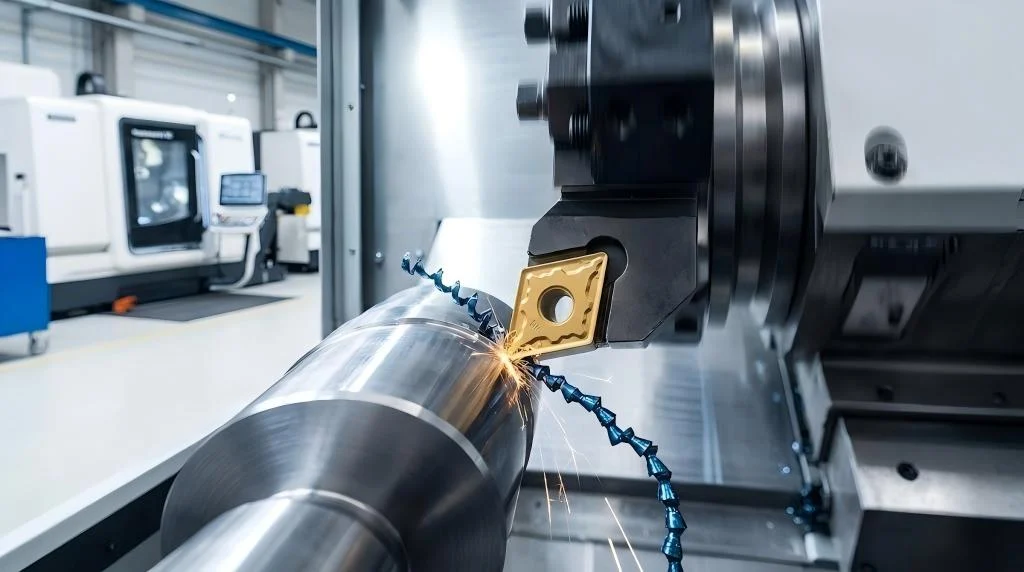
Q4: Why does the chip produced by PCBN turning look like glowing orange wire?
A: This is a visual confirmation of a perfect hard turning process. Because PCBN has poor thermal conductivity, up to 80% of the heat is forced directly into the chip, causing it to reach incandescence before cooling into a dark blue ribbon.
Q5: Can I regrind or resharpen a PCBN insert?
A: Typically not economical. The brazed PCBN tip is very small. Once worn, the insert is indexed to a fresh corner or discarded. Using multi-corner solid PCBN inserts from advanced PCD and PCBN catalogs is the best way to lower your cost-per-edge.
Q6: What causes a sudden, catastrophic failure of a PCBN insert upon entry?
A: Immediate failure upon entry is almost always caused by an incorrect approach parameter. Feeding into a sharp, hardened corner at full feed rate shatters the insert. CNC programmers must utilize a roll-in technique to gradually load the cutting forces onto the T-land chamfer.