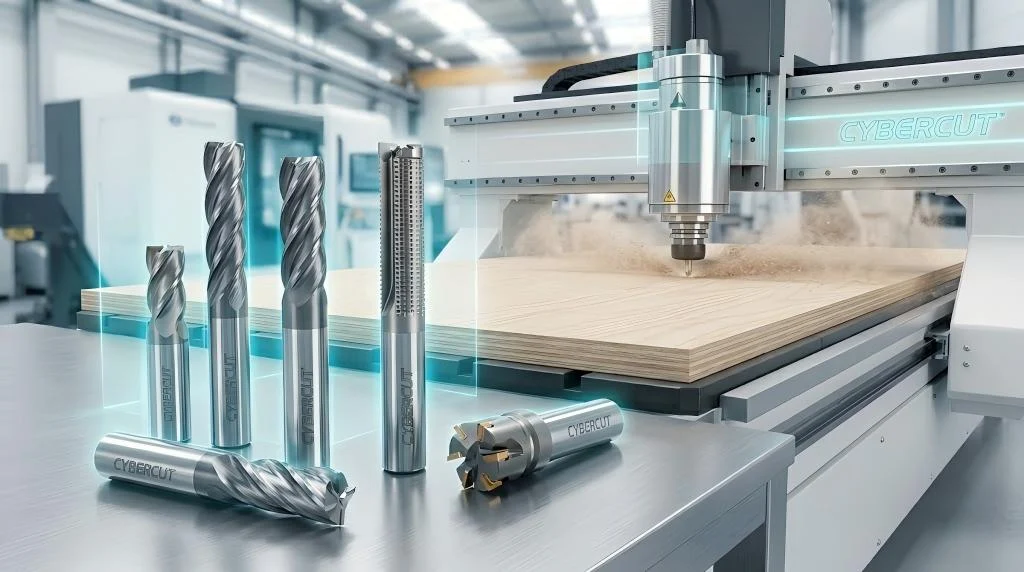

In the highly competitive sector of high-volume furniture manufacturing, cabinet making, and architectural millwork, the efficiency of your CNC nesting and routing operations dictates your facility’s overall throughput and profitability. Unlike hobbyist woodworking—where feed rates are slow and materials are highly forgiving—mass production environments punish tooling. Industrial CNC routers operate at extreme velocities, plowing through miles of highly abrasive engineered composites like MDF, melamine-faced chipboard (MFC), and dense hardwoods.
In this brutal environment, generic tooling will fail rapidly, resulting in unacceptable edge tear-out, burnt workpieces, and crippling machine downtime. To achieve true “lights-out” manufacturing reliability, production engineers must invest in precisely engineered industrial woodworking router bits. The selection process requires a deep understanding of tool metallurgy, flute geometry, and the unique tribological interactions between the cutting edge and the resins found in modern wood composites. This definitive guide will equip you with the technical knowledge to select the optimal router bits for your specific mass-production requirements, drastically reducing your cost-per-linear-foot.
Solid Carbide vs. TCT (Tungsten Carbide Tipped) vs. PCD Bits


The foundation of any high-performance router bit is its metallurgical composition. Wood, particularly when combined with synthetic adhesives in composite panels, is surprisingly abrasive. Choosing the right substrate is a calculation of initial investment versus long-term Cost-Per-Edge (CPE).
1. Solid Carbide (Sub-Micrograin)
Solid carbide router bits are ground from a single, continuous cylindrical blank of cemented tungsten carbide. Modern industrial bits utilize a “sub-micrograin” structure. The continuous solid structure provides immense stiffness, eliminating tool deflection. Manufacturers can grind complex, high-shear flute geometries like compression spirals. However, they are brittle and vulnerable to impact from hard knots or staples.
2. TCT (Tungsten Carbide Tipped)
TCT bits feature a soft, impact-resistant steel tool body with small plates of tungsten carbide silver-brazed onto the cutting edges. TCT is highly economical for massive tool diameters where solid carbide would be prohibitively expensive. However, the brazed joint is a structural weak point under extreme feed rates. To upgrade large-diameter operations, explore premium CNC woodworking tools that feature advanced brazing techniques.
3. PCD (Polycrystalline Diamond)
PCD tooling represents the pinnacle of mass-production technology. Wood composites like MDF are bound with urea-formaldehyde resins containing silica, acting like sandpaper. PCD is virtually immune to this abrasion, lasting 50 to 100 times longer than premium solid carbide. While extremely expensive upfront, it is the ultimate solution for abrasive sheet goods. For high-volume panel processing, a dedicated PCD router bits catalog is your most valuable resource for cost reduction.
Matching the Router Bit Profile to Your Material (MDF, Plywood, Hardwood)


Selecting the correct metallurgical grade is only the first step. The geometric profile of the flutes dictates the direction of the shear force, preventing edge tear-out on veneered panels.
[Image illustrating the shear cutting direction of Up-cut, Down-cut, and Compression router bits in plywood]
Down-Cut Spirals (Downward Shear Force)
The flutes push wood fibers downward into the spoilboard. Best for dadoing, pocketing, and cutting thin, flexible sheet goods. It leaves a flawlessly clean top edge. The catch: chip evacuation is poor. If pushed too fast, friction will ignite the packed chips.
Up-Cut Spirals (Upward Shear Force)
The flutes pull chips up and out of the cut. Best for deep slotting and hole boring in dense solid hardwoods where rapid chip evacuation is critical. The catch: the upward force will aggressively splinter the top veneer of plywood.
Compression Spirals (The Holy Grail for Composites)
A compression bit features an up-cut geometry on the bottom third and a down-cut geometry on the top. When engaged, the bottom pulls up, and the top pushes down. The shear forces meet in the dead center of the panel, guaranteeing a clean cut on both the top and bottom faces simultaneously. When sourcing professional router bits for composites, optimizing mortise compression lengths to match material thickness is critical.
[Table] Feed Rates and RPM Settings for Common Woodworking CNC Operations
Spindle speed (RPM) and feed rate must be mathematically synchronized to achieve the target Chip Load (Feed Rate / (RPM × Number of Flutes)). Here are optimized starting parameters for a standard 1/2″ (12.7mm) 2-flute solid carbide compression bit using specialized woodworking CNC tooling.
| Material Type | Material Density | Target RPM | Feed Rate (IPM) | Feed Rate (m/min) | Target Chip Load |
| MDF / Particleboard | Medium/High (Abrasive) | 18,000 RPM | 600 – 800 IPM | 15.0 – 20.0 | 0.018″ – 0.022″ |
| Veneered Plywood | Variable (Prone to lifting) | 16,000 RPM | 450 – 600 IPM | 11.5 – 15.0 | 0.014″ – 0.018″ |
| Hardwoods (Oak/Maple) | High (Dense) | 14,000 RPM | 300 – 450 IPM | 7.5 – 11.5 | 0.010″ – 0.015″ |
| Softwoods (Pine/Cedar) | Low (Gummy) | 18,000 RPM | 400 – 600 IPM | 10.0 – 15.0 | 0.012″ – 0.016″ |
| Melamine (Double-Sided) | High (Brittle face) | 18,000 RPM | 650 – 850 IPM | 16.5 – 21.5 | 0.018″ – 0.024″ |
*Engineering Note: Always push the feed rate as fast as machine rigidity allows before increasing RPM. Higher feeds transfer heat into the chip.*
Recognizing the Signs of Dull Bits to Prevent Burn Marks
In an automated cell, running a dull tool creates a massive fire hazard. When carbide dulls, it stops shearing and violently rubs cellulose fibers, instantaneously boiling moisture and combusting lignin, creating black scorch marks.
Diagnostic Indicators: 1) Acoustic Changes: A sharp bit emits a crisp hum. A dulling bit emits a high-pitched squeal. 2) Spindle Load Spikes: If your baseline spindle load jumps from 35% to 60%, the tool edge has collapsed. 3) Dust Quality: A sharp tool produces heavy chips; a dull tool produces a cloud of hazardous fine dust.
Proper Storage and Cleaning to Prevent Resin Buildup
A perfectly sharp router bit will perform like a dull one if coated in baked-on wood resin (pitch). Softwoods and composite glues release acidic resins that adhere to hot carbide.
The Physics of Resin Failure
Pitch buildup alters the cutting geometry by filling in the clearance angle. The hardened resin rubs against the cut wall, generating extreme frictional heat that permanently destroys the carbide’s temper.
Industrial Cleaning Protocols
Never use wire brushes, which micro-scratch the polished flutes. Submerge bits in citrus-based solvents for 15-20 minutes. Furthermore, the CNC collet must be cleaned daily. A single flake of dust inside the collet will throw the bit off-center, generating runout (TIR) that destroys tool life. Protect your investments by utilizing industrial wood routing solutions and strict maintenance schedules.
Frequently Asked Questions (FAQ)
Q1: Why are my compression bits tearing out the top veneer of my plywood?
A: This occurs when the depth of cut is shallower than the up-cut portion of the bit, causing up-shear flutes to engage and pull the top veneer. Ensure your pass plunges deeply enough, or look for mortise compression mass production woodworking router bits with shorter up-cut sections.
Q2: How often should I replace the collets on my CNC router?
A: In a high-volume environment running 8-hour shifts, replace collets every 4 to 6 months. Constant heating/cooling causes metal fatigue, resulting in micro-slippage and fatal tool runout.
Q3: Is a 3-flute router bit always better than a 2-flute bit?
A: No. While a 3-flute bit allows higher feed rates, it has smaller gullets. In deep nesting, a 3-flute bit struggles to evacuate chips, leading to chip-packing and breakage. 2-flute bits are the standard for panel processing.
Q4: Can I use PCD (Diamond) bits to cut solid natural hardwoods?
A: It is highly discouraged. Natural hardwoods often contain hard, hidden knots. The impact of striking a dense knot will easily shatter the brittle polycrystalline diamond matrix. PCD is reserved strictly for homogeneous engineered sheets.
Q5: What is “climb cutting” versus “conventional cutting” in wood CNC routing?
A: Conventional cutting moves against rotation, creating a chip that starts thin. Climb cutting moves with rotation, creating a chip that starts thick. Climb cutting leaves a vastly superior surface finish and prevents splintering, but requires a massively rigid gantry router.
Q6: Why is the shank of my router bit turning blue or black?
A: A blue shank indicates catastrophic heat transfer into the spindle. Causes include: 1) the tool is completely dull; 2) feed rate is too slow (rubbing instead of shearing); 3) the collet has lost gripping force, allowing the tool to microscopically spin and slip inside the holder.